How to Improve Reading Speed for CLAT English & Legal Passages
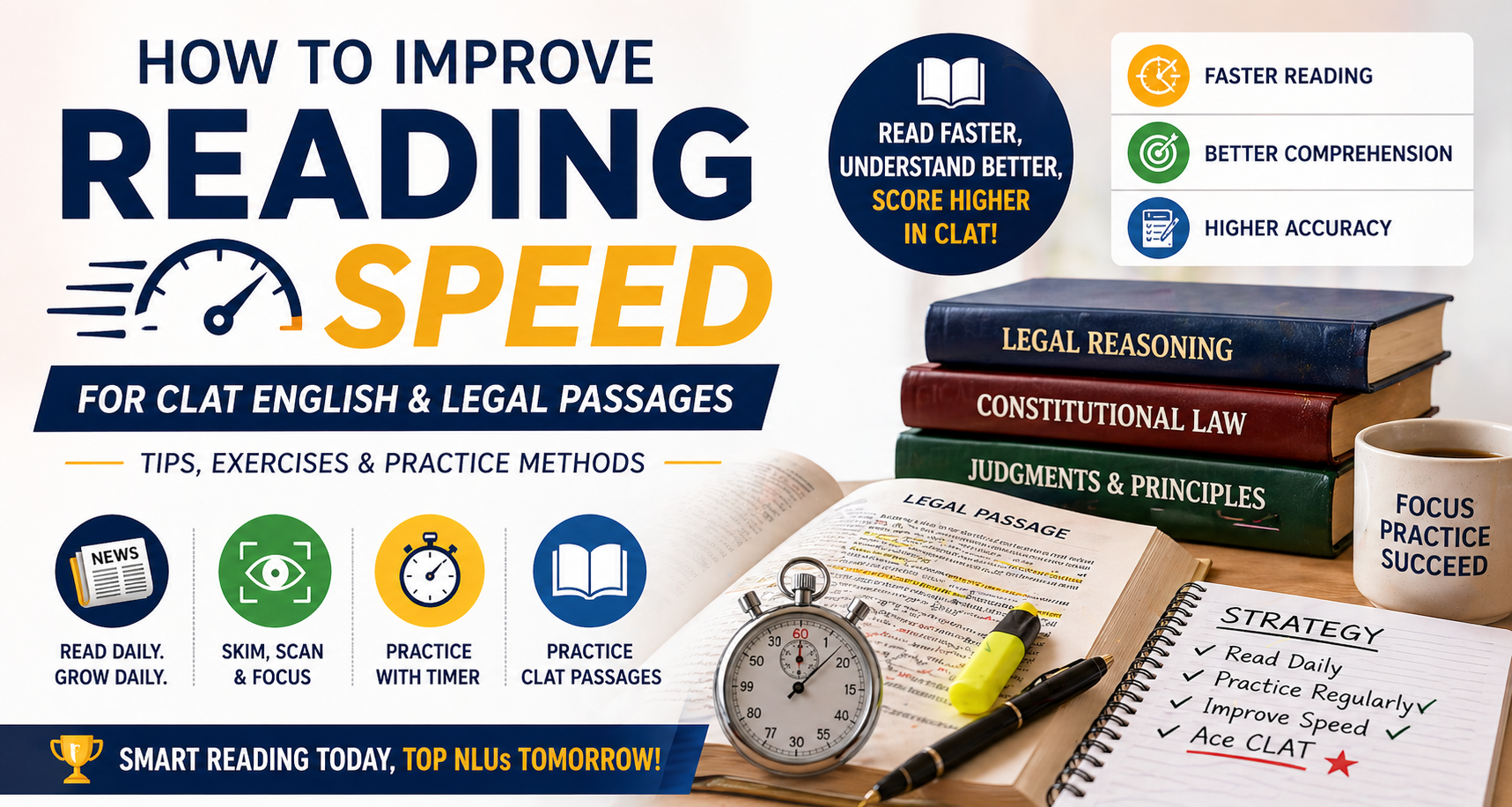
How to Improve Reading Speed for CLAT English & Legal Passages
Effective Tips, Exercises, and Practice Methods for CLAT Aspirants
One of the most important skills required to crack the Common Law Admission Test (CLAT) is fast and accurate reading. In the current CLAT pattern, almost every section—especially English Language, Legal Reasoning, and Logical Reasoning—is based on long comprehension passages.
Students often struggle because they read too slowly or fail to understand the passage quickly. Improving reading speed can significantly increase your score and help you attempt more questions within the limited exam time.
This article explains practical techniques, exercises, and daily practice methods to improve reading speed for CLAT English and legal passages.
Why Reading Speed Matters in CLAT
The Common Law Admission Test contains 120 questions in 120 minutes, and most questions require reading passages before answering.
A typical CLAT paper may include:
i. 5–6 passages in English
ii. 5–6 passages in Legal Reasoning
iii. 4–5 passages in Logical Reasoning
This means students may need to read 30–40 pages of text during the exam.
If your reading speed is slow, you may:
❌ Run out of time
❌ Skip questions
❌ Make comprehension mistakes
Therefore, improving reading speed is essential for both accuracy and time management.
What Is a Good Reading Speed for CLAT?
For CLAT aspirants, an ideal reading speed should be:
i. 250–300 words per minute
ii. With strong comprehension and retention
However, beginners often read at 150–180 words per minute, which can slow down exam performance.
The good news is that reading speed can improve significantly with practice.
Tip 1: Read Newspapers Daily
Daily newspaper reading is the best way to improve reading speed and comprehension.
Recommended newspapers include:
i. The Hindu
ii. The Indian Express
Focus particularly on:
i. Editorials
ii. Opinion articles
iii. Legal or constitutional issues
These articles improve:
✔ vocabulary
✔ analytical thinking
✔ reading speed
Start with 20–30 minutes of reading daily and gradually increase the time.
Tip 2: Stop Subvocalization
Many students silently pronounce each word in their mind while reading. This habit is called subvocalization, and it slows down reading speed.
Instead of reading word by word, train your brain to read phrases or groups of words.
Example
Slow reading:
“The constitution of India guarantees fundamental rights.”
Fast reading:
“The constitution of India / guarantees fundamental rights.”
This technique improves both speed and comprehension.
Tip 3: Practice Skimming and Scanning
Two useful techniques for CLAT passages are:
Skimming
Reading quickly to understand the main idea of the passage.
Focus on:
i. Introduction
ii. Topic sentences
iii. Conclusion
Scanning
Searching quickly for specific information like:
i. Dates
ii. Legal principles
iii. Key facts
These techniques help students locate answers faster during the exam.
Tip 4: Use a Timer While Practicing
Many students read slowly because they never practice under time pressure.
Try this exercise:
- Select a passage (400–500 words).
- Set a timer for 2 minutes.
- Read the passage and summarize it in 2–3 sentences.
This improves:
i. Speed
ii Focus
iii. Comprehension
Tip 5: Improve Vocabulary Gradually
Sometimes reading becomes slow because students do not understand difficult words.
Improving vocabulary helps readers understand passages quickly without stopping.
A highly recommended book is:
i. Word Power Made Easy by Norman Lewis
Students should learn 10–15 new words daily.
Tip 6: Practice CLAT-Level Passages
The best preparation method is to practice actual CLAT-style passages.
Focus on topics commonly used in CLAT:
i. Law and constitution
ii. Public policy
iii. Ethics and philosophy
iii. Social issues
iv. International relations
Practice solving passages and answering questions within a time limit.
Exercises to Improve Reading Speed
Here are some simple exercises that can significantly improve reading speed.
Exercise 1: Pointer Method
Use your finger or a pen to guide your eyes while reading.
This method:
✔ increases reading pace
✔ prevents distractions
✔ improves focus
Exercise 2: Chunk Reading
Train your eyes to read 3–4 words together instead of one word at a time.
Example:
Instead of reading
“Law students must develop strong analytical skills”
Read
“Law students must / develop strong / analytical skills”
This technique improves speed dramatically.
Exercise 3: Daily Passage Practice
Follow this simple routine:
i. Read 2 editorial articles daily
ii. Solve 2 comprehension passages
iii. Summarize each passage in 3 sentences
Within 2–3 months, students usually notice significant improvement in reading speed.
Weekly Practice Plan for CLAT Reading
Here is a simple weekly plan:
Daily
i. 30 minutes newspaper reading
ii. 2 comprehension passages
iii. Vocabulary practice
3 times per week
i. Solve timed CLAT passages
Weekly
i.Attempt a sectional test for English or Legal Reasoning
Consistency is the key to improvement.
Common Mistakes Students Make
Many CLAT aspirants unknowingly slow down their reading due to these mistakes:
❌ Reading every word slowly
❌ Going back repeatedly to previous lines
❌ Trying to memorize the entire passage
❌ Ignoring daily reading practice
Instead, students should focus on understanding the overall argument of the passage.
Final Advice for CLAT Aspirants
Improving reading speed is not something that happens overnight. It requires daily practice and disciplined reading habits.
Students preparing for the Common Law Admission Test should read extensively, practice timed passages, and develop strong comprehension skills.
Within a few months of consistent practice, aspirants will notice:
✔ Faster reading speed
✔ Better understanding of passages
✔ Improved accuracy in comprehension questions
Ultimately, strong reading skills can become your biggest advantage in CLAT.
✅ Quick Tip: Students who read editorials daily and practice 3–4 passages regularly often perform significantly better in English and Legal Reasoning sections.

You may also like
-

How to Start Preparing for CLAT from Class 11
24 April, 2026 -

Top 10 Mistakes to Avoid During CLAT Preparation
7 April, 2026