CLAT 2027 Pattern Change: Expert Committee Reforms, Expected Changes & Preparation Strategy
CLAT 2027 Pattern Change: What We Know So Far About the Biggest Reform in CLAT History
Updated: 16 June 2026
The Common Law Admission Test (CLAT) is likely to witness its most significant transformation since the introduction of the comprehension-based format in 2020. The Consortium of National Law Universities (NLUs) has constituted an independent Expert Committee to review and redesign the CLAT examination for both UG and PG programmes from CLAT 2027 onwards.
For CLAT 2027 aspirants, this development has generated both excitement and uncertainty. While the Consortium has confirmed that reforms are under consideration, the detailed recommendations of the Expert Committee have not yet been publicly released, leading to widespread speculation among students and educators.
In this article, we analyse the available information, expected changes, and what CLAT 2027 aspirants should do right now.
Why Was the CLAT 2027 Expert Committee Formed?
Following repeated concerns regarding question quality, answer key disputes, paper-setting standards, and overall examination structure, the Advisory Board of the Consortium of NLUs decided to establish a Committee of Independent Academic Experts to suggest medium and long-term reforms for CLAT.
The Committee has been tasked with examining:
✔ Quality of questions
✔ Structure of the examination
✔ CLAT syllabus
✔ Best practices followed by international law entrance examinations such as LSAT and LNAT
The Consortium also invited public suggestions and feedback from students, teachers, and stakeholders during October-November 2025.
Who Are the Experts Reviewing CLAT?
The committee comprises some of the most distinguished legal academics in the world:
✔ Prof. Dev Saif Gangjee (University of Oxford) – Co-Chair
✔ Prof. Tarunabh Khaitan (London School of Economics) – Co-Chair
✔ Prof. Shyamkrishna Balganesh (Columbia Law School)
✔ Prof. Pritam Baruah (BML Munjal University)
✔ Prof. Surabhi Ranganathan (University of Cambridge)
The committee was constituted under the chairmanship of former Supreme Court Judge Justice Indu Malhotra.
The presence of globally renowned academics suggests that the Consortium is considering structural reforms rather than merely cosmetic changes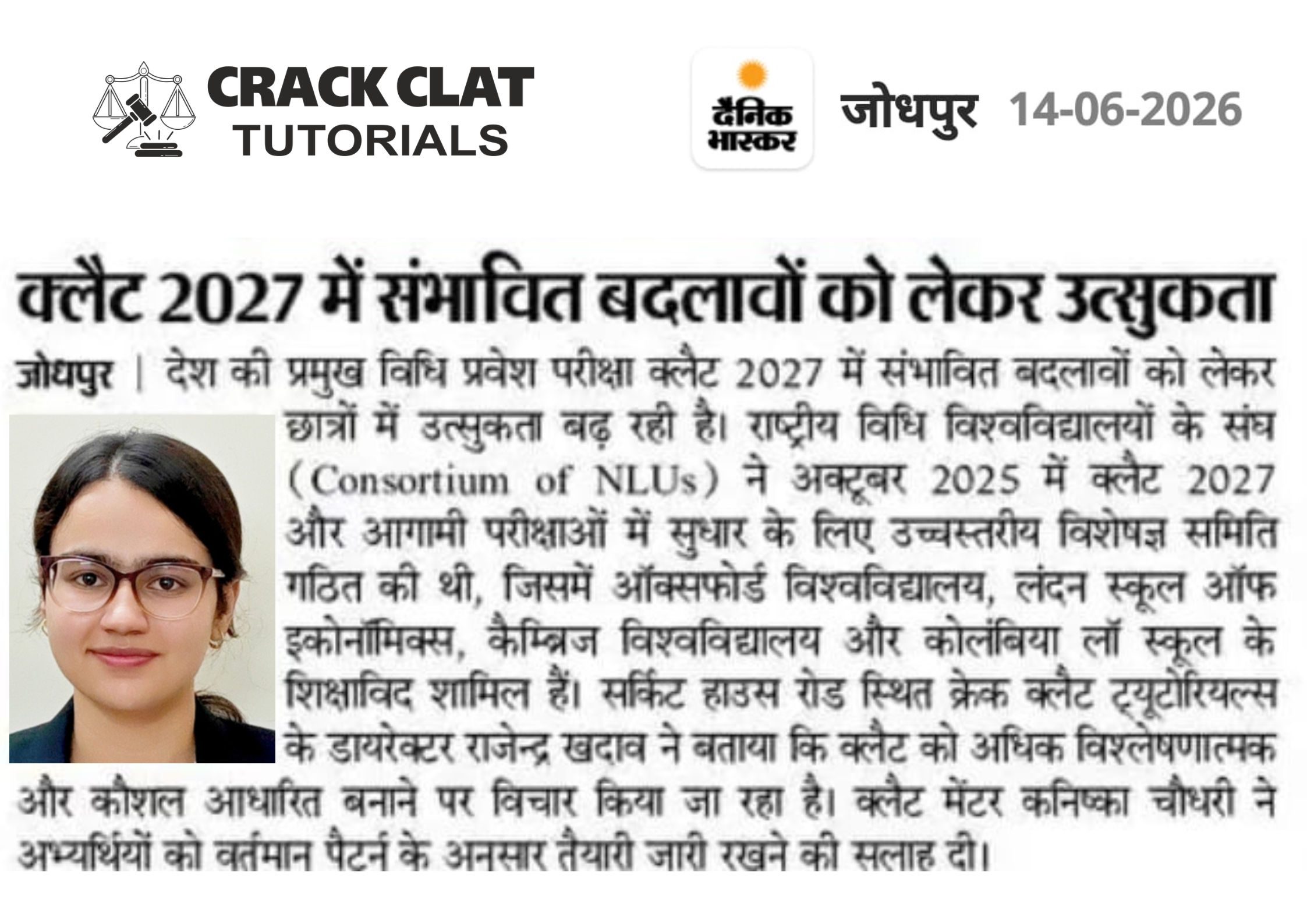
Why Are Aspirants Concerned?
According to reports, the Expert Committee submitted its recommendations several months ago, but the Consortium has not yet officially disclosed the report. As a result, CLAT 2027 aspirants are preparing without knowing whether the examination pattern, syllabus, or marking structure will change significantly.
Many students have expressed concerns regarding:
✔ Uncertainty in preparation strategy
✔ Lack of transparency
✔ Possibility of sudden changes close to the examination
✔ Difficulty in selecting study materials and coaching plans
The delay has become one of the most discussed issues among CLAT 2027 aspirants.
What Changes Are Expected in CLAT 2027?
Although the Consortium has not released the final recommendations, several broad possibilities emerge from the Committee’s mandate and discussions across the legal education community.
- Greater Focus on Critical Reasoning
Experts expect CLAT to move closer to international aptitude tests such as LSAT and LNAT.
Possible implications:
✔ More analytical questions
✔ Deeper inference-based reasoning
✔ Reduced dependence on memorisation
✔ Increased emphasis on argument evaluation
Students may need stronger critical thinking skills rather than merely mastering shortcuts.
- Improved Question Quality
One of the committee’s explicit objectives is improving question quality.
Future CLAT papers may feature:
✔ Better drafted passages
✔ More precise answer choices
✔ Reduced ambiguity
✔ Fewer controversial questions
This could help minimise post-exam litigation and answer key disputes.
- Revision of Sectional Weightage
The Consortium may revisit the distribution of questions across sections.
Possible areas of review:
✔ Current Affairs & GK
✔ Legal Reasoning
✔ Logical Reasoning
✔ English Language
✔ Quantitative Techniques
However, there is currently no official confirmation regarding any specific change in sectional weightage.
- Changes in Passage Design
The committee is studying international law admission tests, particularly LSAT and LNAT.
As a result, future CLAT papers may feature:
✔ Longer analytical passages
✔ Denser reading material
✔ More abstract reasoning
✔ Multi-layered comprehension questions
This would reward genuine reading ability and conceptual understanding.
- Syllabus Rationalisation
The committee has also been asked to review the syllabus.
Potential reforms may include:
✔ Clearer syllabus boundaries
✔ Better-defined learning outcomes
✔ Reduced overlap between sections
✔ More predictable examination framework
Such changes could make CLAT preparation more structured.
Will the Number of Questions Change?
There has been considerable speculation regarding changes in the number of questions and overall structure. However, as of now, the Consortium has not officially announced any alteration in:
✔ Number of questions
✔ Duration of examination
✔ Marking scheme
✔ Offline examination mode
Students should avoid relying on rumours until an official notification is issued.
How Should CLAT 2027 Aspirants Prepare Right Now?
The safest strategy is to prepare for skills that will remain valuable regardless of any reform.
Focus on Reading
Develop a habit of reading:
✔ Newspapers
✔ Editorials
✔ Legal articles
✔ Opinion pieces
✔ International affairs analysis
Build Critical Reasoning Skills
Practice:
✔ Assumptions
✔ Inferences
✔ Strengthen and weaken arguments
✔ Logical flaws
✔ Analytical reasoning
Prioritise Conceptual Learning
Avoid rote memorisation.
Future CLAT reforms are likely to reward:
✔ Understanding
✔ Interpretation
✔ Application
✔ Analytical thinking
Continue Preparing According to the Existing Pattern
Until the Consortium officially announces changes, aspirants should continue preparing according to the current CLAT framework while simultaneously strengthening reading and reasoning abilities.
What Should We Expect Next?
The official CLAT 2027 notification is expected in the coming months and will likely clarify:
✔ Final examination pattern
✔ Number of questions
✔ Sectional structure
✔ Syllabus modifications
✔ Any new assessment methodology
Until then, students should remain cautious about unverified claims circulating on social media.
Final Thoughts
The CLAT 2027 reform process represents a potentially historic moment for legal education admissions in India. With an expert panel comprising scholars from Oxford, Cambridge, Columbia, and LSE, the Consortium appears committed to making CLAT a more rigorous, transparent, and intellectually rewarding examination.
While uncertainty remains regarding the final recommendations, one thing is clear: future CLAT aspirants will need stronger reading comprehension, critical reasoning, and analytical skills than ever before.
At Crack CLAT, we will continue tracking every official development and provide timely updates, expert analysis, and preparation guidance as soon as the Consortium releases the final CLAT 2027 framework.
Stay tuned with CrackCLAT.com for all CLAT 2027 updates.
Tag:CLAT 2027, CLAT 2027 Exam Pattern, CLAT 2027 Pattern Change, CLAT 2027 Reforms, CLAT Expert Committee, CLAT Latest News, CLAT Logical Reasoning, CLAT New Pattern, CLAT Preparation, CLAT Reading Comprehension, CLAT Syllabus Changes, CLAT UG 2027, Consortium of NLUs, Law Entrance Exam, NLU Admissions