Supreme Court Declares Right to Walk on Footpaths a Fundamental Right: What CLAT Aspirants Must Know
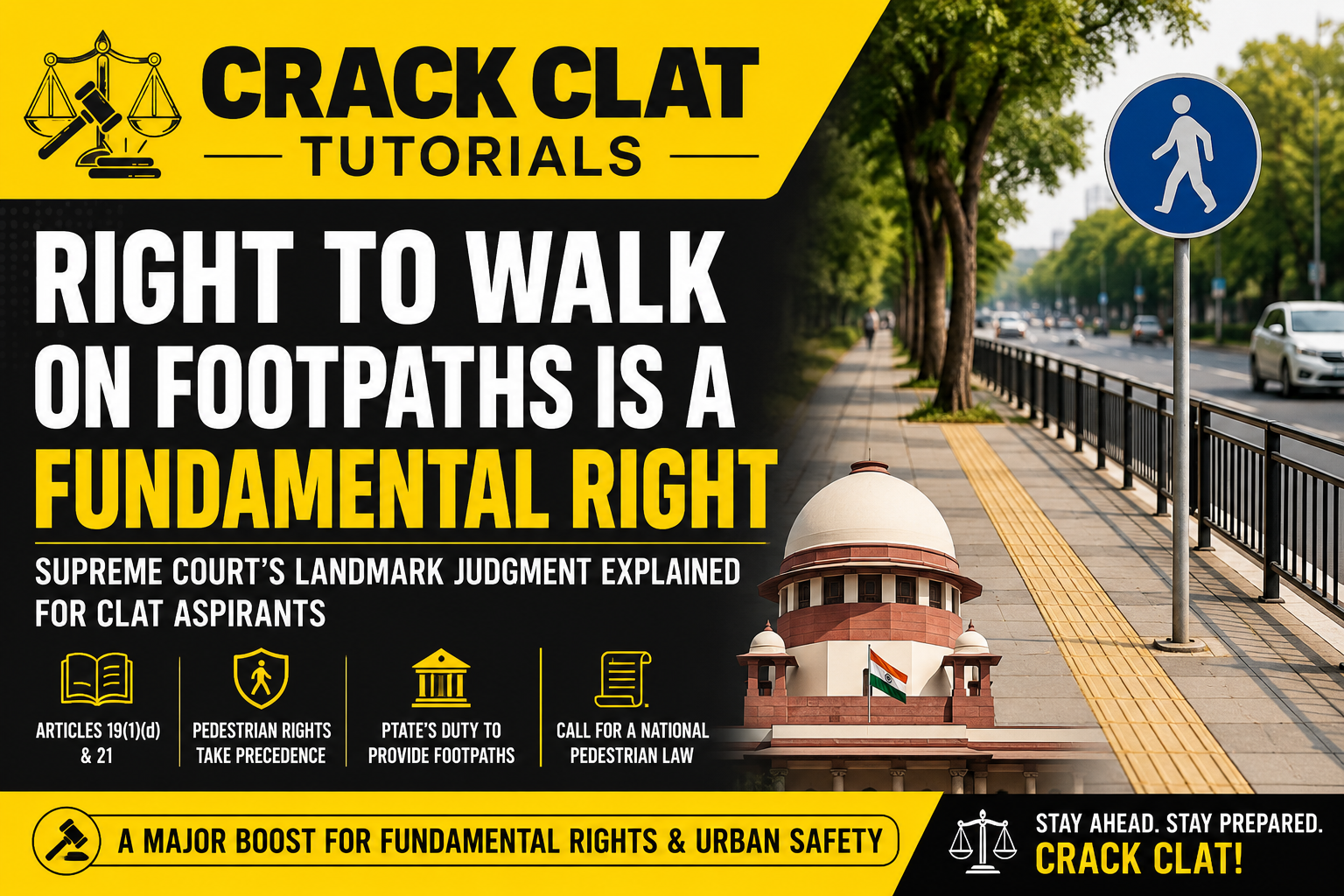
Right to Walk on Footpaths is a Fundamental Right: Supreme Court’s Landmark Judgment Explained for CLAT Aspirants
Supreme Court Expands the Scope of Fundamental Rights
In a landmark judgment delivered on 19 June 2026, the Supreme Court of India held that the right to walk safely on demarcated footpaths is a Fundamental Right protected under the Constitution. The Court emphasized that pedestrians’ rights must take precedence over motorised vehicles and directed authorities to ensure the availability and maintenance of safe footpaths.
This decision is significant not only for urban planning and road safety but also for CLAT aspirants because it demonstrates how the judiciary interprets Fundamental Rights expansively to protect citizens’ dignity, safety, and freedom of movement.
Background of the Case
The judgment arose from a tragic motor accident involving a five-year-old child who was walking to school with his father. The child was fatally hit by a tanker on a road that lacked both a pedestrian crossing and a proper footpath. While hearing the matter, the Supreme Court examined a broader constitutional question: Do citizens have a fundamental right to safe walking infrastructure?
The Court answered this question in the affirmative and used the opportunity to strengthen pedestrian rights across India.
What Did the Supreme Court Hold?
The Bench observed that:
The right to walk is a Fundamental Right and includes the right to safe, accessible, and demarcated footpaths.
The Court held that this right flows from:
✔ Article 19(1)(d) – Freedom to move freely throughout the territory of India.
✔ Article 21 – Right to life and personal liberty.
✔ The broader constitutional values of dignity, safety, and equal participation in public spaces.
Importantly, the Court declared that pedestrian rights are primary and cannot be subordinated to the convenience of motor vehicles.
Constitutional Significance
This judgment is another example of the Supreme Court’s expansive interpretation of Fundamental Rights.
Over the years, the Court has read several unenumerated rights into Article 21, such as:
✔ Right to Privacy
✔ Right to Livelihood
✔ Right to Clean Environment
✔ Right to Education (before it became an explicit constitutional right)
✔ Right to Dignified Living
Now, the right to walk safely joins this growing list of rights derived from constitutional guarantees.
The judgment reinforces the idea that Fundamental Rights are living concepts that evolve with societal needs.
Duties of Government Authorities
The Court clarified that whenever a road exists, there is a corresponding obligation on public authorities to provide and maintain footpaths.
The responsibility lies with:
✔ Urban Development Authorities
✔ Municipal Corporations
✔ Municipalities
✔ Panchayats
Failure to ensure safe pedestrian infrastructure may amount to a violation of constitutional rights.
Call for a National Pedestrian Law
Recognising the absence of a comprehensive legal framework for pedestrians, the Supreme Court recommended the creation of a dedicated legislative framework to protect the right to walk.
Such a law could:
✔ Define pedestrian rights.
✔ Establish accountability mechanisms.
✔ Provide remedies for violations.
✔ Ensure uniform standards for footpath design and maintenance.
This reflects the Court’s growing concern about road safety, accessibility, and inclusive urban development.
Why Is This Important for CLAT Aspirants?
This judgment is highly relevant for:
- Legal Reasoning
Questions may test:
✔ Interpretation of Fundamental Rights.
✔ Relationship between Articles 19 and 21.
✔ Judicial activism and constitutional morality.
✔ Balancing public infrastructure and individual rights.
- Current Affairs
The judgment is a major legal development from 2026 and may feature in CLAT, AILET, SLAT, and other law entrance examinations.
- Constitutional Law Concepts
Students should understand:
✔ Expansive interpretation of Article 21.
✔ Positive obligations of the State.
✔ Public interest jurisprudence.
✔ Evolution of Fundamental Rights.
Key Takeaways for CLAT 2027
✔ Supreme Court declared the right to walk on demarcated footpaths a Fundamental Right.
✔ The right derives primarily from Articles 19(1)(d) and 21.
✔ Pedestrian rights take precedence over motorised traffic.
✔ Authorities have a constitutional duty to provide and maintain safe footpaths.
✔ The Court recommended a comprehensive legal framework for pedestrian protection.
✔ The judgment strengthens the trend of expanding Fundamental Rights through judicial interpretation.
Crack CLAT Expert Insight
For CLAT aspirants, this case is an excellent example of how constitutional principles operate in real life. The Supreme Court transformed a road accident compensation dispute into a broader discussion on dignity, mobility, accessibility, and state responsibility. Such judgments often become the basis of Legal Reasoning passages because they require students to apply constitutional principles to practical situations.
As CLAT increasingly focuses on contemporary legal developments, understanding landmark judgments like this can significantly improve both legal awareness and reasoning skills.
Tag:Article 19(1)(d), Article 21 Constitution of India, CLAT 2027 Current Affairs, CLAT Current Affairs, CLAT GK, CLAT Legal Reasoning, Constitutional Law, Crack CLAT Tutorials, Landmark Judgments India, Law Entrance Exam Current Affairs, Legal Awareness, Pedestrian Rights, Right to Walk Fundamental Right, Supreme Court Judgment 2026, Supreme Court News