CLAT Expert Committee Report 2026: What It Actually Means for CLAT 2027 (And Why CLAT 2028 Is the Year to Watch)
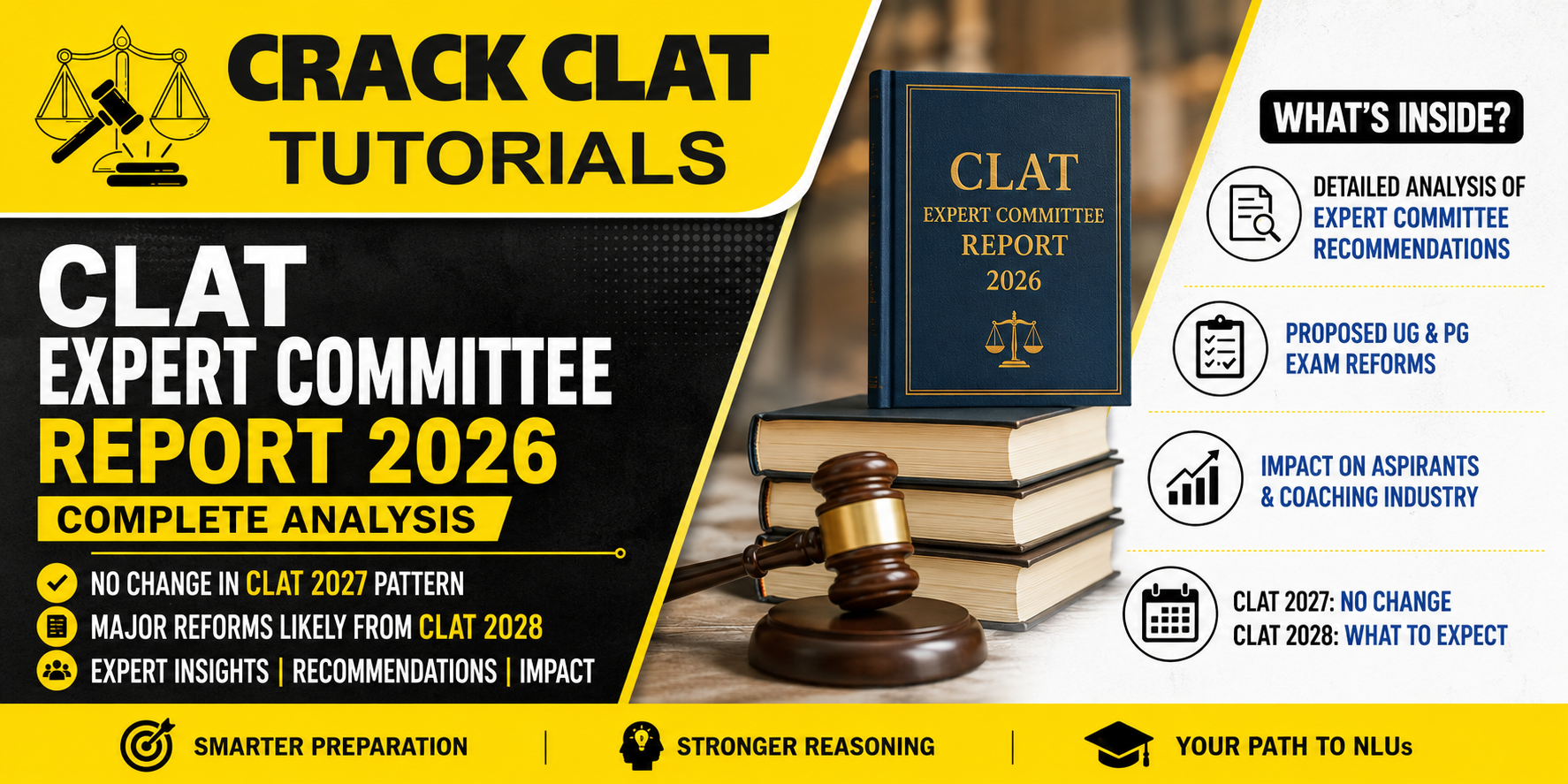
CLAT Expert Committee Report 2026 Explained: No Pattern Change for CLAT 2027, But Major Reforms Likely from CLAT 2028
Updated on 22 July 2026, 11:09 AM IST
If you’ve been following the CLAT reform conversation, you’ve probably seen headlines about a “major overhaul” of the exam. Some of that is true — but not for the year most aspirants think. Here’s a clear-eyed breakdown of the CLAT Expert Committee Report 2026 and the Consortium’s official response, so you know exactly what to prepare for.
The Backstory: Why This Committee Was Formed
The Consortium of National Law Universities set up an Expert Committee in September 2025 to review CLAT’s question quality, paper structure, syllabus, and how it compares to international tests like the LSAT and LNAT. The five-member Committee — drawn from Oxford, LSE, Columbia, Cambridge, and BML Munjal University — wasn’t assembled on a whim. It followed years of litigation over exam errors, including a Supreme Court observation that it was left with “deep anguish regarding the callous and casual manner” in which the Consortium had been framing questions.
The Committee submitted its Final Report on 2 February 2026, after public consultation and input from NLU Vice-Chancellors.
The Most Important Update: CLAT 2027 Will NOT Change Structurally
This is the detail every serious aspirant needs to internalize. On 18 July 2026, the Consortium’s Governing Body met and passed a press release with a decisive line:
“There will be no changes to the syllabus and pattern/sections of the UG and PG papers in CLAT 2027.”
That means:
✔ CLAT 2027 UG will still have five sections: English Language, Current Affairs/GK, Legal Reasoning, Logical Reasoning, and Quantitative Techniques.
✔ 120 questions, 2 hours, +1/−0.25 marking stays as is.
✔ The Committee’s headline proposal — collapsing these into three sections (Logical Reasoning & Legal Aptitude, Language & Comprehension, Quantitative Techniques) and scrapping GK entirely — has been deferred, likely to CLAT 2028, pending further review by a new committee to be constituted by the Office of the Chief Justice of India.
So if you’ve seen prep content built entirely around a “new three-section CLAT,” pump the brakes — that’s a 2028 story, not a 2027 one.
So What DOES Change for CLAT 2027?
The Governing Body did ask the CLAT 2027 Convenor and paper-setters to “consider and adopt the suggestions of the CLAT Expert Committee Report regarding question format and quality in a feasible manner.” In plain English: same structure, but hopefully better-made questions.
The Report is unusually candid about what’s gone wrong in past papers, and this gives us a strong signal of what setters will likely try to fix:
- The “verbatim answer” problem. The Committee found that in several past papers, correct answers could simply be located word-for-word in the passage — turning comprehension questions into a copy-paste exercise. One cited example: a question about Macbeth where the answer was lifted directly from the passage text. Expect setters to move away from this in 2027.
- Ambiguous or multi-answer questions. The Report gives an uncomfortable example from a past Logical Reasoning paper where the “correct” answer wasn’t even the most defensible one among the options. This kind of flaw has driven real litigation — in Siddhi Sandeep Ladda v. Consortium of National Law Universities (2025 INSC 714), the Supreme Court ordered four erroneous questions withdrawn and expressed sharp displeasure at the Consortium’s drafting process.
- Testing prior legal knowledge in a supposedly “aptitude-only” exam. The Report flags Legal Reasoning questions that assumed familiarity with specific Contract Act provisions — contradicting the CLAT’s own stated purpose of testing aptitude, not memorized law. One Vice-Chancellor quoted in the Report put it bluntly: asking pre-law students about Contract or Criminal Law “benefits coaching centres more than law schools.”
- Thematic repetition and predictability. Topics like juvenile justice, data protection, and corporate consultancy have recurred across years, which the Committee says rewards “coaching on predictable themes rather than genuine aptitude.”
What This Means for Your CLAT 2027 Prep
✔ Don’t restructure your study plan around a three-section exam. Prepare for the current five-section format: English, GK/Current Affairs, Legal Reasoning, Logical Reasoning, Quantitative Techniques.
✔ Stop relying on “find the answer in the passage” shortcuts. If setters take the Committee’s critique seriously, verbatim-matching strategies will work less often. Practice genuine inference, tone recognition, and argument evaluation instead.
✔ Don’t over-invest in memorizing bare acts and case law for Legal Reasoning. The Report explicitly criticizes testing “prior legal knowledge” in what’s meant to be an aptitude test. Focus on applying given legal principles to new facts rather than recalling specific provisions.
✔ Watch for tighter, less ambiguous Logical Reasoning questions. Precision matters more than pattern-recognition tricks — practice questions where only one answer is truly defensible, and get comfortable eliminating “almost right” options.
✔ Follow official Consortium notifications closely, not rumors. Since paper-setters have discretion in how they “feasibly adopt” the Report’s suggestions, the only binding source of truth will be Consortium announcements — including any sample papers or notifications closer to the exam date.
Looking Ahead to CLAT 2028
The press release also reveals that the real structural transformation is being routed through a new committee to be constituted by the Office of the Chief Justice of India, working in coordination with the Consortium’s Governing Body, factoring in public feedback (submissions are open until 31 August 2026) ahead of CLAT 2028 — not 2027. If the Committee’s original vision is eventually adopted, CLAT 2028 aspirants could see:
✔ A streamlined three-section UG paper
✔ Removal of the standalone GK/Current Affairs section
✔ Rule-application and rule-derivation style Logical Reasoning questions (hypothetical rules applied to invented facts, no prior legal knowledge required)
✔ A possible constructed-response essay component down the line, though the Committee itself recommended holding off on this due to evaluation-at-scale concerns
We’ll cover that transition in detail as more concrete decisions emerge.
Bottom Line
CLAT 2027 will look familiar in structure but should — in theory — feel better made: fewer ambiguous questions, less verbatim-passage matching, and less reliance on random legal trivia. The real overhaul is being saved for CLAT 2028, pending further institutional review. Prepare for the exam you’ll actually sit, not the one currently being drafted on paper.
Stay tuned to crackclat.com for updates as the Consortium releases further notifications on CLAT 2027.