CLAT 2026 Paper Analysis & Strategy for CLAT 2027
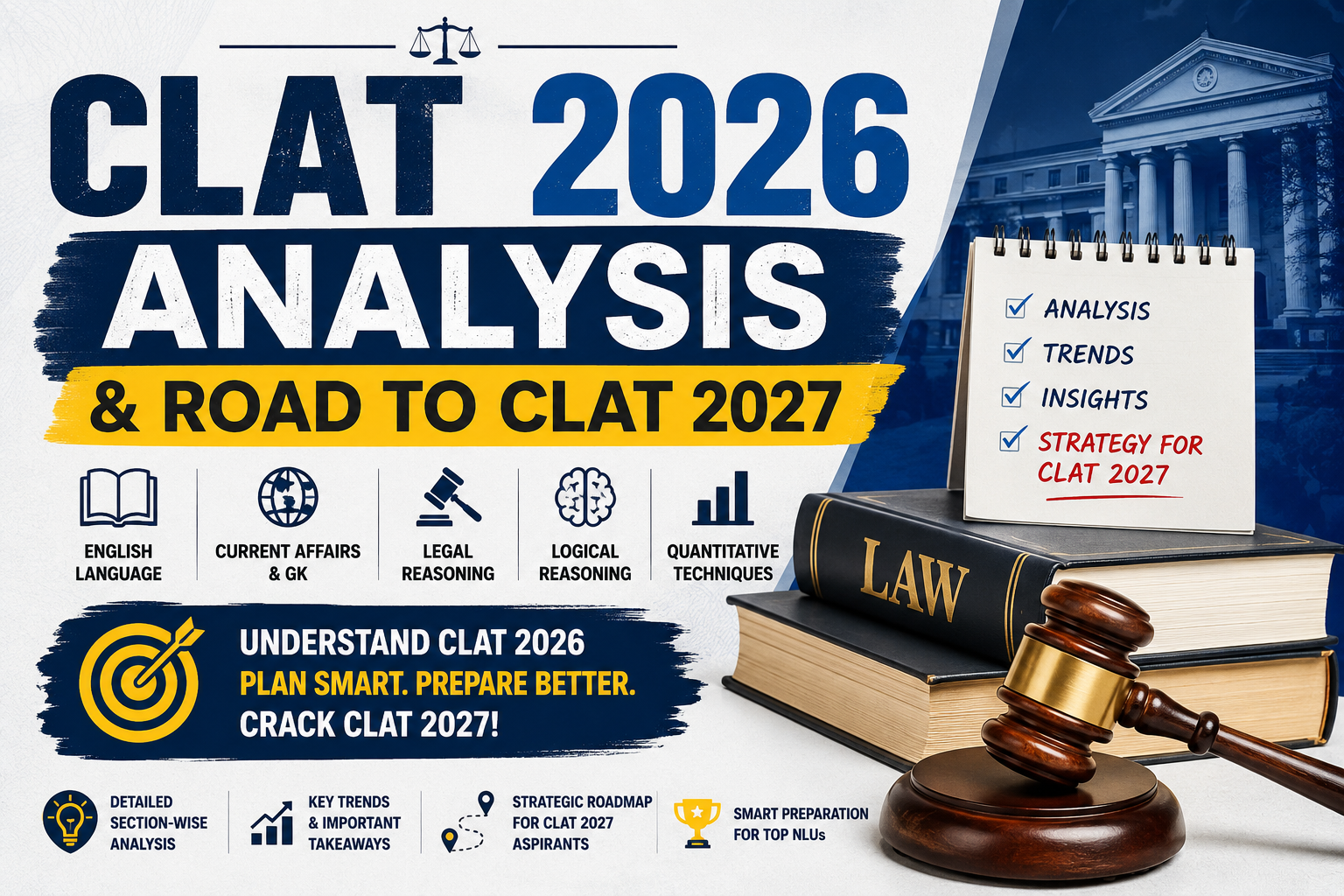
CLAT 2026 Paper Analysis & Strategy for CLAT 2027: Section-Wise Review, Difficulty Level & Preparation Roadmap
The CLAT 2026 question paper reflects the continuing evolution of the Common Law Admission Test towards a comprehension-heavy, application-based, and concept-driven exam. Candidates who appeared for CLAT 2026 would have noticed a clear emphasis on reading ability, logical interpretation, and current affairs integration rather than rote memorization.
In this blog, we break down the CLAT 2026 paper analysis and provide a complete roadmap for CLAT 2027 aspirants.
📊 Overall CLAT 2026 Paper Analysis
CLAT 2026 maintained its standard 120-question format, divided across five sections:
✔ English Language
✔ Current Affairs & GK
✔ Legal Reasoning
✔ Logical Reasoning
✔ Quantitative Techniques
Key Highlights:
✔ Moderate to slightly difficult paper
✔ Lengthy passages dominated all sections
✔ Heavy reliance on reading comprehension skills
✔ Current affairs deeply integrated with static knowledge
✔ Legal reasoning tested principles + application, not legal knowledge
📘 Section-Wise Analysis
- English Language
The English section featured passage-based questions from diverse sources, including history, literature, and philosophy.
Observed Trends:
✔ RC passages from sources like historical movements, human evolution, and literature
✔ Vocabulary questions based on context (e.g., “incognisant”, “boorish”)
✔ Tone, inference, and main idea questions
Difficulty Level: Moderate
👉 Takeaway for CLAT 2027:
Focus on:
✔ Daily reading (editorials + non-fiction)
✔ Vocabulary in context
✔ RC practice with time constraints
- Current Affairs & GK
This section was highly current affairs-driven, covering major national and international developments.
Major Topics Covered:
✔ International relations (India-US relations, H-1B visa)
✔ Sports achievements (Chess World Cup)
✔ Government policies and schemes
✔ International organizations (SCO Summit)
✔ Important incidents (Air India AI-171 case)
Difficulty Level: Moderate
👉 Takeaway for CLAT 2027:
✔ Follow last 10–12 months of current affairs
✔ Focus on context-based GK, not static mugging
✔ Revise from reliable monthly compilations
- Legal Reasoning
The legal section continued its shift toward principle-fact application with passage-based questions.
Key Areas:
✔ Constitutional law (Preamble, Governor powers)
✔ Landmark judgments (same-sex marriage, Tamil Nadu Governor case)
✔ Governance and constitutional morality
Difficulty Level: Moderate to Difficult
👉 Takeaway for CLAT 2027:
✔ Focus on legal reasoning practice, not legal theory
✔ Solve passage-based questions daily
✔ Understand recent Supreme Court judgments
- Logical Reasoning
Logical reasoning included analytical puzzles, critical reasoning, and inference-based questions.
Question Types:
✔ Analytical puzzles (family relations, scheduling)
✔ Assumption, inference, conclusion
✔ Strengthen/weaken arguments
Difficulty Level: Moderate
👉 Takeaway for CLAT 2027:
✔ Practice critical reasoning sets daily
✔ Focus on accuracy over speed
✔ Solve high-level puzzles regularly
- Quantitative Techniques
The Quant section was based on data interpretation sets, not direct math.
Topics Covered:
✔ Ratios and percentages
✔ Data analysis (health insurance, electricity data)
✔ Caselet-based calculations
Difficulty Level: Easy to Moderate
👉 Takeaway for CLAT 2027:
✔ Strengthen basic arithmetic concepts
✔ Practice DI sets regularly
✔ Improve calculation speed
🎯 Key Observations from CLAT 2026
✔ Reading is the ultimate skill
Every section required strong comprehension.
✔ Current affairs + static integration is crucial
Questions were not direct but contextual.
✔ Legal reasoning is about logic, not law
No prior legal knowledge needed.
✔ Time management is decisive
Lengthy passages made time handling critical.
🚀 Roadmap for CLAT 2027 Aspirants
📅 1-Year Preparation Strategy
Phase 1 (Foundation: 3–4 months)
✔ Build reading habit (The Hindu, Indian Express)
✔ Learn basics of legal reasoning & logical reasoning
✔ Start GK monthly notes
Phase 2 (Concept + Practice: 4–5 months)
✔ Solve sectional tests daily
✔ Start mock tests (1–2 per week)
✔ Revise current affairs regularly
Phase 3 (Advanced Prep: 2–3 months)
✔ Increase mocks to 3–4 per week
✔ Focus on weak areas
✔ Practice full-length timed papers
Phase 4 (Final Revision: Last 1 month)
✔ Revise GK thoroughly
✔ Analyze previous year papers
✔ Focus on accuracy and speed
📚 Best Preparation Tips for CLAT 2027
✔ Read 2–3 RC passages daily
✔ Attempt daily legal reasoning sets
✔ Revise GK weekly + monthly
✔ Analyze every mock test deeply
✔ Focus on quality over quantity
🏁 Final Thoughts
CLAT 2026 clearly signals that the exam is no longer about memorization but about thinking like a law aspirant—analytical, aware, and precise.
For CLAT 2027, the winning strategy will be:
👉 Strong reading habits
👉 Consistent mock practice
👉 Smart current affairs preparation
If you align your preparation with these trends, cracking CLAT 2027 becomes not just possible—but highly achievable.