Passport Is Not Proof of Citizenship? India’s Legal Position Explained | CLAT Current Affairs 2027
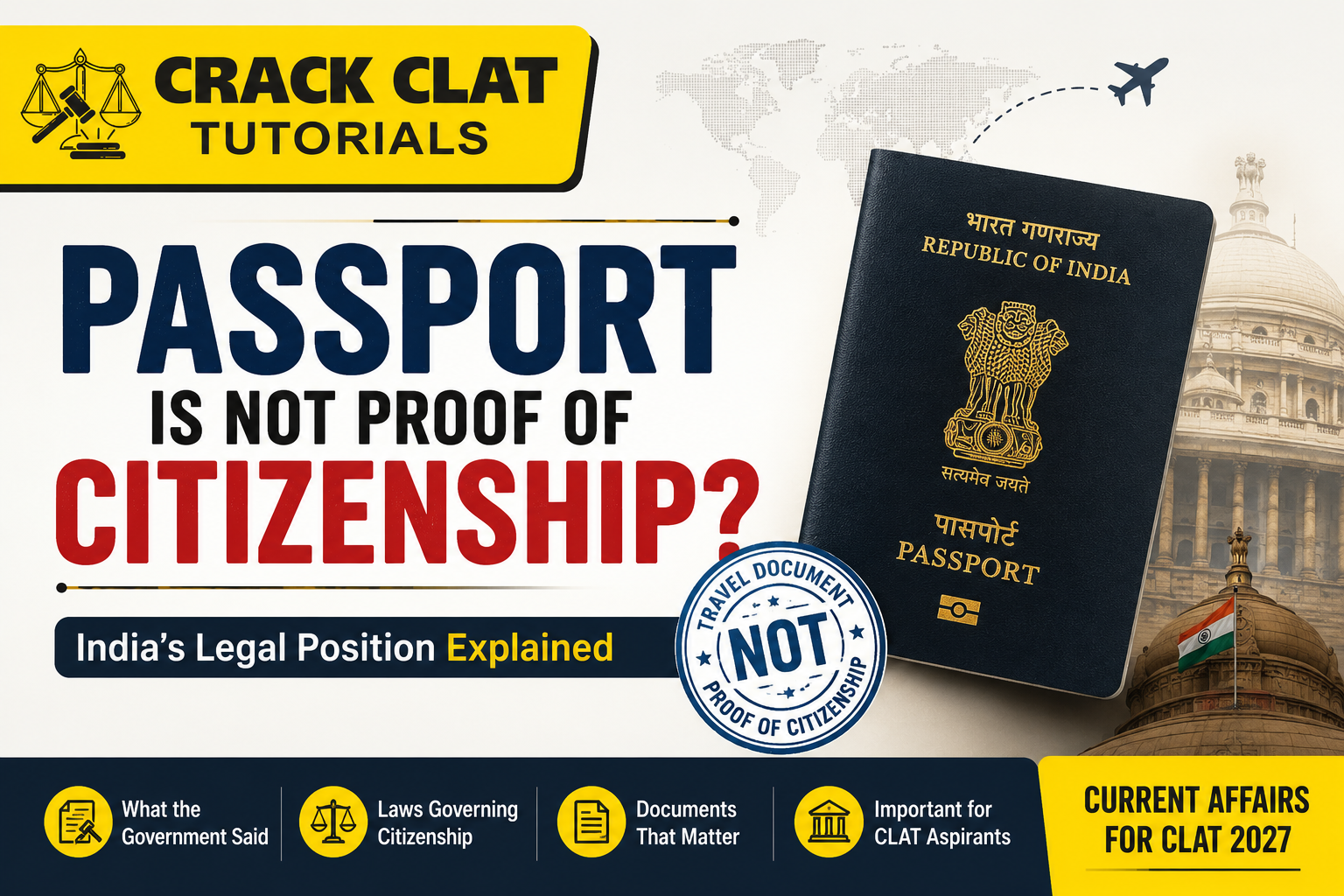
Passport Is Not Proof of Citizenship? Understanding India’s Legal Position
A statement by the Ministry of External Affairs (MEA) in June 2026 sparked widespread debate after officials clarified that an Indian passport is a travel document and not conclusive proof of Indian citizenship.
Many people were surprised because passports are commonly treated as evidence of nationality. However, the government’s clarification reflects India’s existing legal framework rather than a new law.
For CLAT aspirants, this issue is important because it combines Constitutional Law, Citizenship, Governance, Current Affairs, and Legal Reasoning.
Why Did the Debate Begin?
During Passport Seva Divas 2026, senior MEA officials clarified that:
- A passport primarily enables international travel.
- It establishes the holder’s identity and nationality for travel purposes.
- It should not be treated as a legally conclusive document proving citizenship in every situation.
The clarification triggered discussions on social media because many citizens believed that possessing a passport automatically proved Indian citizenship. The government later explained that this legal distinction has always existed under Indian law.
Why Isn’t a Passport Conclusive Proof of Citizenship?
A passport is issued after verification by passport authorities.
However, its legal purpose is different.
It certifies that the Government of India requests foreign countries to allow the holder to travel internationally and provide necessary protection.
Citizenship, on the other hand, is determined under:
- The Constitution of India (Articles 5–11)
- The Citizenship Act, 1955
- Rules framed under the Act
Therefore, a passport is strong evidence of nationality and identity, but citizenship itself is governed by separate laws and legal processes.
How Is Indian Citizenship Determined?
The Citizenship Act, 1955 provides five methods of acquiring Indian citizenship:
- By Birth
Citizenship acquired based on the date and conditions of birth in India.
- By Descent
Citizenship inherited through Indian parents.
- By Registration
Available for certain categories such as Persons of Indian Origin and spouses of Indian citizens.
- By Naturalisation
Foreign nationals may obtain citizenship after fulfilling residence and other legal requirements.
- By Incorporation of Territory
When a new territory becomes part of India.
If Passport Isn’t Conclusive Proof, What Documents May Be Relevant?
Unlike several countries, India does not issue one universal citizenship certificate to every citizen by birth.
Depending on the legal situation, authorities may examine:
- Birth Certificate
- Parents’ citizenship records
- Citizenship Certificate (for registration or naturalisation cases)
- Government records establishing eligibility under the Citizenship Act
- Other legally admissible evidence
The exact documents depend on the context and applicable law. There is no single document that universally proves citizenship for every Indian citizen.
Difference Between Identity, Nationality and Citizenship
| Term | Meaning |
| Identity | Establishes who a person is. |
| Nationality | Indicates association with a country, especially for international travel. |
| Citizenship | A legal status granting constitutional and statutory rights within a country. |
Understanding this distinction is essential for legal reasoning questions in CLAT.
Constitutional Provisions
The Constitution originally dealt with citizenship in Part II (Articles 5–11).
These Articles determined citizenship at the commencement of the Constitution and empowered Parliament to enact citizenship laws.
Parliament subsequently enacted the Citizenship Act, 1955.
Important Laws to Remember
Citizenship Act, 1955
- Acquisition of citizenship
- Termination of citizenship
- Registration
- Naturalisation
Passports Act, 1967
- Regulates issue of passports
- Governs travel documents
- Does not define citizenship itself
Why Is This Important for CLAT?
This issue can appear in:
Current Affairs
Government clarification regarding passports and citizenship.
Legal Reasoning
Questions involving statutory interpretation and legal distinctions.
Constitutional Law
Articles 5–11, Parliamentary powers, and citizenship.
General Knowledge
Difference between passport, Aadhaar, voter ID and citizenship documentation.
Key Takeaways
- A passport is primarily a travel document.
- Indian citizenship is governed by the Constitution and the Citizenship Act, 1955.
- India does not issue one universal citizenship certificate to every citizen.
- Different legal situations may require different forms of evidence regarding citizenship.
- Understanding the distinction between identity documents and citizenship is crucial for CLAT aspirants.
CLAT 2027 Exam Tips
Whenever you study current affairs, don’t just memorise the news.
Always connect it with:
- Constitutional provisions
- Important statutes
- Supreme Court judgments
- Fundamental Rights
- Governance concepts
This integrated approach helps in both the Current Affairs and Legal Reasoning sections of CLAT.
Frequently Asked Questions (FAQs)
Is an Indian passport proof of citizenship?
It is strong evidence of nationality and identity for travel, but under Indian law it is not considered conclusive proof of citizenship in every legal context.
Which law governs Indian citizenship?
The Citizenship Act, 1955.
Which law governs passports?
The Passports Act, 1967.
Can a person have an Indian passport without being legally entitled to citizenship?
A passport is issued after verification, but if it was obtained through fraud or error, it does not by itself conclusively establish citizenship. Citizenship is ultimately determined under the Citizenship Act and applicable legal procedures.
Tag:Citizenship Act 1955, citizenship documents India, citizenship law India, CLAT 2027, CLAT Current Affairs, CLAT Preparation, Constitution of India, Constitutional Law, Crack CLAT Tutorials, current affairs 2026, general knowledge for CLAT, Indian citizenship, Indian passport, Indian polity, Law Entrance Exam, legal GK, legal reasoning, MEA passport clarification, passport is not proof of citizenship, passport news India, passport not proof of citizenship, passport vs citizenship, Passports Act 1967, proof of citizenship India