Supreme Court Refuses to Modify Stray Dog Relocation Order: A Landmark Judgment Balancing Public Safety and Animal Welfare
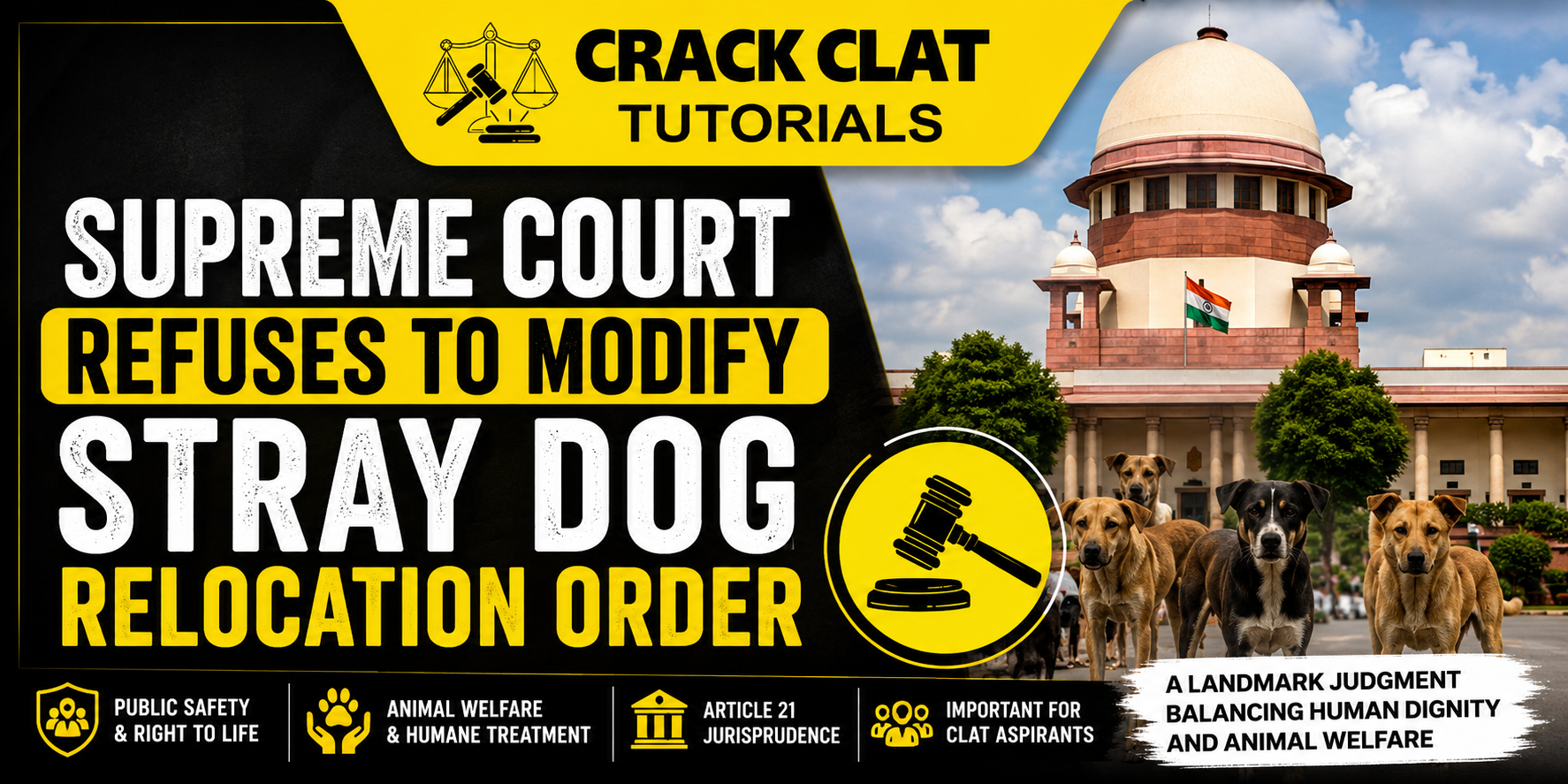
The Supreme Court of India has refused to modify its November 7, 2025 order directing all States and Union Territories to remove stray dogs from schools, hospitals, railway stations, bus depots, and other crowded public institutions. The decision reinforces the Court’s view that the constitutional right to life includes the right to live without fear of dog attacks.
This judgment is highly significant for CLAT aspirants because it touches on Article 21 of the Constitution, public health, animal welfare law, and judicial activism.
Background of the Case
The issue arose from a suo motu petition titled In Re: “City Hounded by Strays, Kids Pay Price”, in which the Supreme Court examined the increasing number of dog-bite incidents across India. According to figures placed before the Court, nearly 37 lakh dog-bite cases were reported in 2024, prompting urgent judicial intervention.
On November 7, 2025, the Court ordered authorities to:
✔Capture stray dogs from sensitive public places,
✔ Sterilise and vaccinate them,
✔ Shift them to designated shelters, and
✔ Prevent their return to the same institutional areas.
Animal welfare organisations later sought modifications, arguing that India lacks adequate shelter infrastructure and that mass relocation may be impractical. On May 19, 2026, the Court rejected these pleas.
What the Supreme Court Held
The Bench observed that courts cannot remain “blind to harsh realities.” It emphasized that children, elderly citizens, patients, and commuters must be protected from stray dog attacks.
The Court reaffirmed that:
✔ The right to life and dignity under Article 21 includes safety from dog attacks.
✔ Governments must create sufficient shelters and sterilisation facilities.
✔ Public safety and animal welfare must be balanced.
✔ Delays in implementation are unacceptable.
Key Directions Issued by the Court
The Court directed States and Union Territories to:
- Remove Stray Dogs from Public Institutions
Dogs found in schools, colleges, hospitals, sports complexes, railway stations, and bus depots must be shifted to shelters after sterilisation and vaccination.
- Strengthen Infrastructure
Authorities must build designated shelters and expand sterilisation and vaccination programs.
- Improve Waste Management
Public institutions must adopt proper waste disposal systems to reduce food sources that attract stray dogs.
- Maintain Anti-Rabies Supplies
Hospitals must ensure continuous availability of anti-rabies vaccines and immunoglobulins.
- Conduct Awareness Programs
Educational institutions should educate students and staff about dog-bite prevention and first aid.
Constitutional and Legal Significance
Article 21 – Right to Life and Dignity
The Court interpreted Article 21 broadly to include protection from avoidable threats to physical safety.
Prevention of Cruelty to Animals Act, 1960
The judgment respects animal welfare principles while stressing effective implementation.
Animal Birth Control Rules, 2023
The Court acknowledged the statutory framework but modified how it should operate in high-risk public spaces.
Why This Case Matters for CLAT Aspirants
This case is important because it combines:
✔ Constitutional Law
✔ Environmental and Animal Law
✔ Public Health Governance
✔ Judicial Review
✔ Contemporary Legal Current Affairs
Possible CLAT questions may focus on:
✔ Article 21 jurisprudence,
✔ Balancing competing rights,
✔ The role of the judiciary in policy implementation,
✔ Animal welfare legislation.
Critical Analysis
The decision highlights a modern constitutional approach where rights are balanced rather than treated in isolation. The Court recognized the importance of compassion toward animals but held that public safety, particularly the protection of children and vulnerable persons, cannot be compromised.
The judgment also underscores the Court’s willingness to issue detailed administrative directions when executive authorities fail to act effectively.
Conclusion
The Supreme Court’s refusal to modify its stray dog relocation order is a landmark decision that balances human dignity and public safety with humane treatment of animals. For CLAT aspirants, it offers an excellent example of how constitutional principles, statutory law, and judicial reasoning intersect in real-world legal controversies.
At Crack CLAT Tutorials, we believe that mastering such legal current affairs is essential for success in CLAT and other law entrance examinations.