US Supreme Court Upholds Birthright Citizenship: Explained for CLAT 2027
US Supreme Court Upholds Birthright Citizenship: A Landmark Constitutional Decision
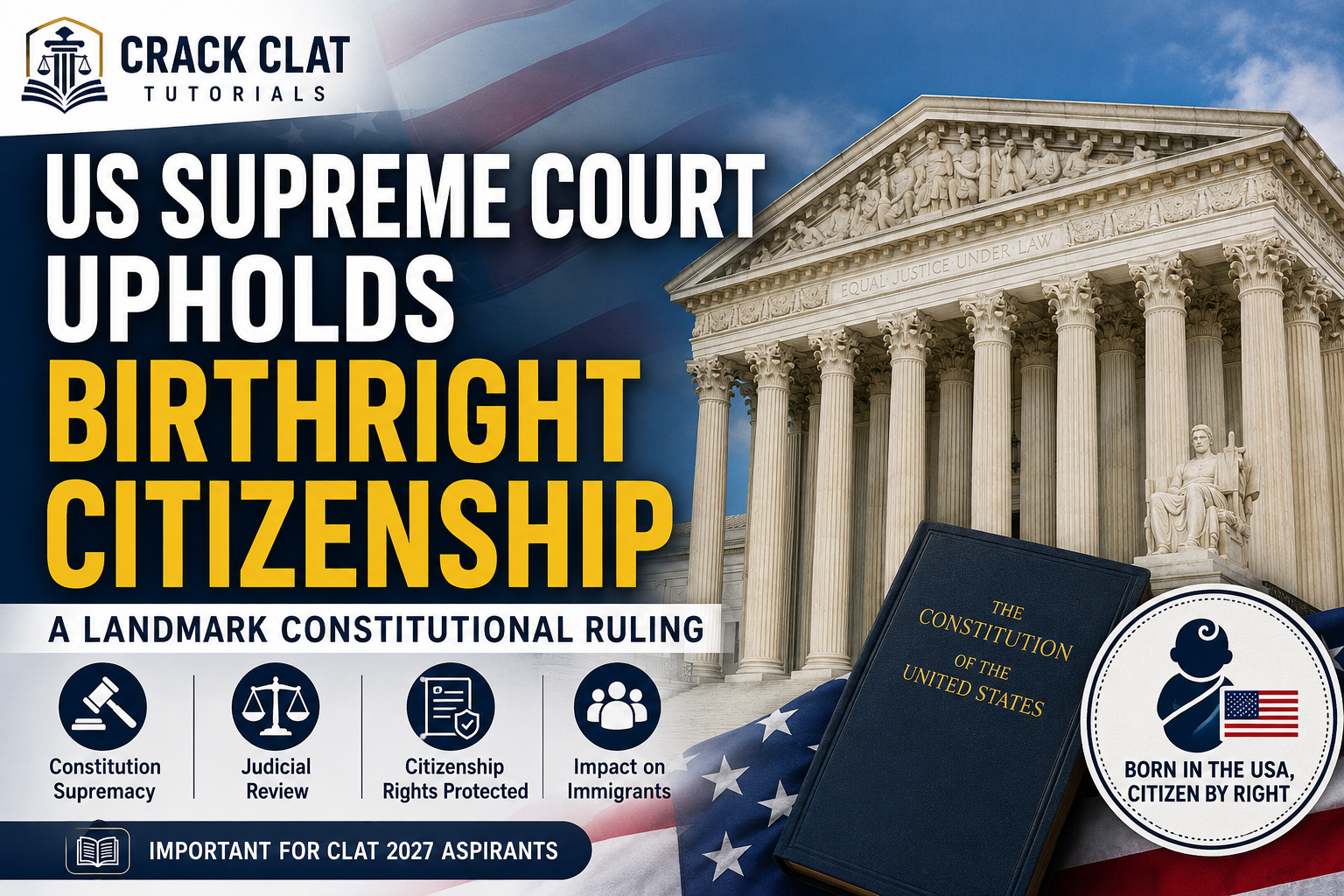
In a major constitutional ruling, the United States Supreme Court has reaffirmed the principle of birthright citizenship, striking down former President Donald Trump’s executive order that sought to deny automatic citizenship to certain children born in the United States.
The judgment has become one of the most important international constitutional developments of 2026 and is highly relevant for CLAT UG 2027 aspirants because it combines constitutional law, legal reasoning, citizenship, executive powers, judicial review, and current affairs.
What is Birthright Citizenship?
Birthright citizenship is the principle that a person automatically becomes a citizen of a country simply by being born within its territory, regardless of the nationality or immigration status of the parents.
This principle is known as Jus Soli, a Latin phrase meaning “right of the soil.”
Countries generally follow one of two principles:
- Jus Soli (Right of the Soil)
Citizenship is granted based on the place of birth.
Examples include:
- United States
- Canada
- Mexico
- Jus Sanguinis (Right of Blood)
Citizenship depends on the nationality of one or both parents rather than the place of birth.
Countries like India, Germany, Japan, and many European nations primarily follow this principle.
What Did Donald Trump Attempt to Change?
After returning to office, President Donald Trump signed an Executive Order seeking to deny automatic citizenship to children born in the United States if:
- Both parents were undocumented immigrants, or
- Parents were temporarily present in the country on visas.
The administration argued that the existing interpretation of the Constitution encouraged illegal immigration and “birth tourism.”
However, several states, immigrant rights organisations, and affected families challenged the executive order before federal courts.
What Did the US Supreme Court Decide?
The US Supreme Court, in a 6–3 majority judgment, ruled that the executive order violated the Citizenship Clause of the Fourteenth Amendment of the US Constitution.
The Court reaffirmed that:
- Anyone born on US soil and subject to US jurisdiction is a US citizen.
- The President cannot alter constitutional citizenship through an executive order.
- Any such constitutional change would require an amendment to the Constitution rather than unilateral executive action.
The ruling reaffirmed the long-standing constitutional interpretation established more than a century ago.
Constitutional Basis: The Fourteenth Amendment
The decision is rooted in the Fourteenth Amendment of the US Constitution (adopted in 1868).
Its Citizenship Clause states:
“All persons born or naturalized in the United States, and subject to the jurisdiction thereof, are citizens of the United States.”
The amendment was originally enacted after the American Civil War to guarantee citizenship to formerly enslaved persons and prevent discrimination.
The Historic Wong Kim Ark Case
The Supreme Court relied upon the landmark 1898 decision in United States v. Wong Kim Ark.
In that case, the Court held that:
- A child born in the United States to Chinese immigrant parents was an American citizen.
- Birth within US territory ordinarily confers citizenship regardless of the parents’ nationality.
This precedent has remained the foundation of birthright citizenship for over 125 years.
Why Was Trump’s Executive Order Held Unconstitutional?
The Court observed that:
- The President cannot rewrite constitutional provisions through executive action.
- Executive Orders must remain consistent with the Constitution.
- Citizenship rights protected by the Constitution cannot be removed without constitutional amendment.
This judgment reinforces one of the core principles of constitutional democracy:
The Constitution is supreme over executive power.
Constitutional Principles Involved
This judgment touches upon several constitutional doctrines important for law entrance examinations.
Constitutional Supremacy
The Constitution remains the highest law.
Judicial Review
Courts possess the authority to invalidate unconstitutional executive actions.
Separation of Powers
The Executive cannot assume powers reserved for the Constitution or Legislature.
Rule of Law
Government actions must comply with constitutional limitations.
Why is the Judgment Significant?
The ruling is significant because it:
- Protects constitutional citizenship rights.
- Reaffirms judicial independence.
- Limits executive overreach.
- Clarifies the scope of presidential powers.
- Impacts hundreds of thousands of children born annually in the United States.
Birthright Citizenship vs Indian Citizenship
Unlike the United States, India does not grant unconditional birthright citizenship.
India originally followed a broader birth-based citizenship model but has progressively restricted it through amendments to the Citizenship Act, 1955.
Today, citizenship by birth depends upon:
- Date of birth
- Citizenship status of parents
- Whether either parent is an illegal migrant
Thus, India primarily follows a modified Jus Sanguinis approach rather than absolute Jus Soli.
Frequently Asked Questions (FAQs)
What is birthright citizenship?
Birthright citizenship is the automatic acquisition of citizenship based on a person’s place of birth.
Why did the US Supreme Court reject Trump’s executive order?
The Court held that the order violated the Fourteenth Amendment and that constitutional citizenship cannot be changed through executive action.
Does India follow birthright citizenship?
No. India follows a modified citizenship-by-descent model under the Citizenship Act, 1955, with specific conditions for citizenship by birth.
Why is this topic important for CLAT?
It connects current affairs with constitutional law, judicial review, executive powers, and comparative constitutional principles—frequently tested themes in CLAT.
Final Words
The US Supreme Court’s ruling on birthright citizenship is more than a political or immigration issue—it is a reaffirmation of constitutional governance, the rule of law, and the limits of executive power. For CLAT aspirants, this judgment is an excellent case study in comparative constitutional law and legal reasoning, making it an important topic for the 2027 examination.
Tag:Birthright Citizenship, Citizenship Clause, CLAT 2027, CLAT Current Affairs, CLAT Daily Current Affairs, CLAT Exam 2027, CLAT GK, CLAT International Affairs, CLAT Legal Reasoning, CLAT Preparation, CLAT Study Material, Constitutional Law, Donald Trump, Fourteenth Amendment, Judicial Review, Law Entrance Exam, Trump Executive Order, US Constitution, US Supreme Court, US Supreme Court Birthright Citizenship