Best Strategy for CLAT Logical Reasoning
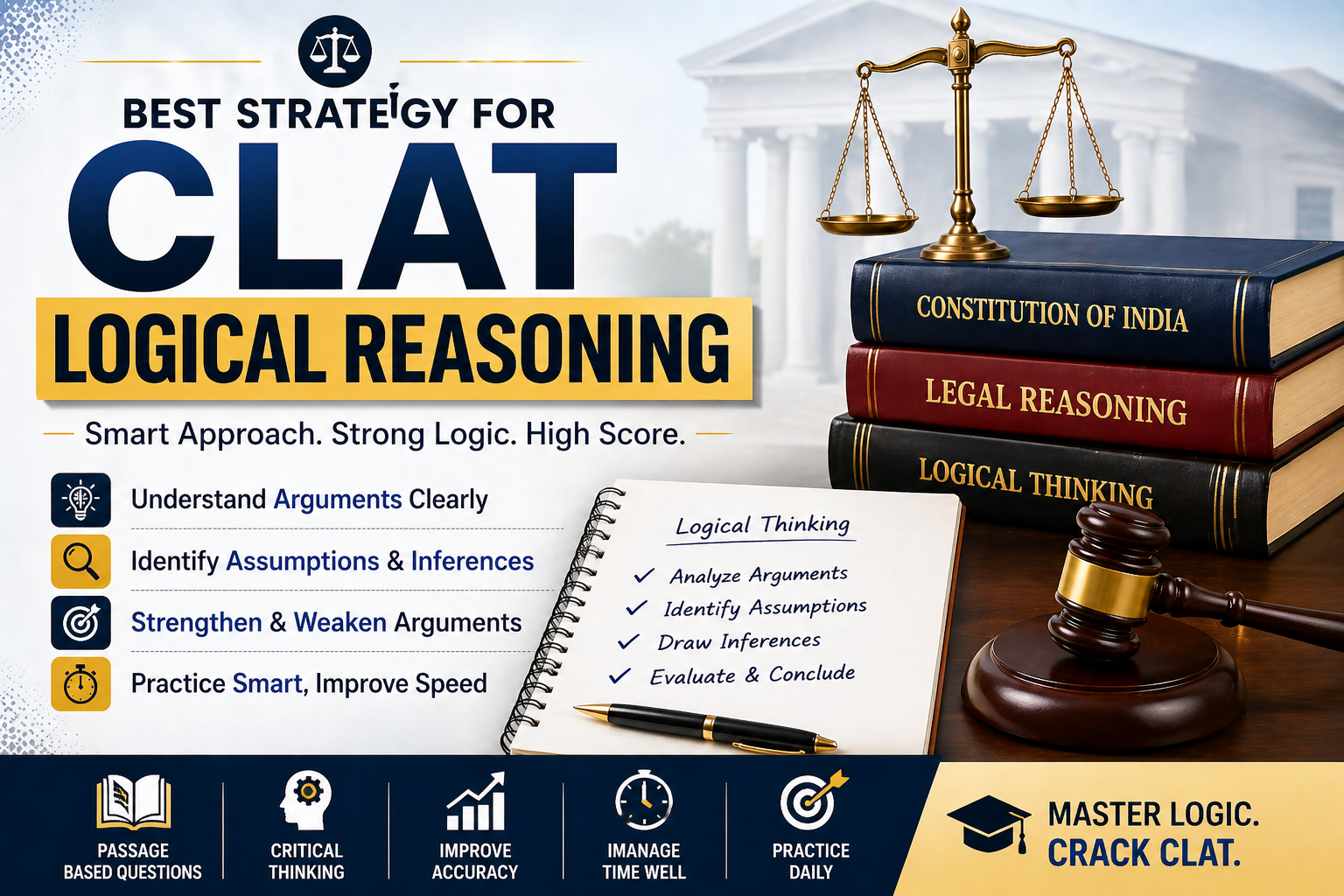
Best Strategy for CLAT Logical Reasoning
A Complete Guide to Improve Accuracy, Speed & Score High
The Logical Reasoning section in the Common Law Admission Test (CLAT) is one of the most scoring yet tricky parts of the exam. It usually contains 22–26 questions, all based on passage-driven critical reasoning.
Unlike traditional reasoning exams, CLAT focuses on understanding arguments, analysing viewpoints, and drawing logical conclusions—not puzzles or rote formulas.
This guide will help you master CLAT Logical Reasoning with the right strategy, practice methods, and tips.
Understanding CLAT Logical Reasoning
In the Common Law Admission Test, Logical Reasoning includes:
✔ Short passages (300–400 words)
✔ Followed by 4–5 questions per passage
Question Types:
✔ Arguments & conclusions
✔ Assumptions
✔ Inferences
✔ Strengthen/Weaken arguments
✔ Cause & effect
✔ Analogies
📌 The focus is on critical thinking, not calculations.
Why Logical Reasoning is Important
✔ High scoring section
✔ Improves overall rank
✔ Helps in Legal Reasoning too
✔ Less factual, more skill-based
Students who prepare well can score 20+ marks easily.
Step-by-Step Strategy for CLAT Logical Reasoning
- Focus on Understanding the Passage
The first step is to read the passage carefully.
While reading, identify:
✔ Main argument
✔ Author’s opinion
✔ Supporting points
✔ Conclusion
📌 Do not rush—understanding the passage correctly saves time later.
- Identify Argument Structure
Every passage has a structure:
✔ Premises → supporting statements
✔ Conclusion → final claim
Example:
“Online education is effective because it provides flexibility.”
Here:
✔ Premise → provides flexibility
✔ Conclusion → online education is effective
Understanding this structure helps in solving most questions.
- Learn Key Question Types
Assumption Questions
Find what is implicitly assumed.
Inference Questions
Choose what must be true based on the passage.
Strengthen/Weaken
✔ Strengthen → supports the argument
✔ Weaken → challenges the argument
📌 Practice identifying these patterns.
- Eliminate Wrong Options
CLAT options are designed to confuse.
Use elimination:
❌ Extreme statements
❌ Irrelevant options
❌ Outside knowledge
✔ Choose the option that best fits the passage logic
- Avoid Using Outside Knowledge
Always answer based on the given passage only.
Even if you know the real-world answer, ignore it if it contradicts the passage.
- Improve Reading Speed
Logical Reasoning passages are lengthy.
To improve speed:
✔ Read editorials from The Hindu
✔ Practice daily comprehension
✔ Learn to read in chunks
- Practice Regularly
Consistency is key.
Daily practice should include:
✔ 2–3 logical reasoning passages
✔ Timed practice sessions
✔ Error analysis
Best Books for Logical Reasoning
Recommended resources:
✔ Analytical Reasoning – M. K. Pandey
✔ A Modern Approach to Logical Reasoning – R. S. Aggarwal
✔ Previous year CLAT papers
Daily Practice Routine
1–2 Hours Plan:
✔ 30 min – Reading editorials
✔ 40 min – Logical reasoning passages
✔ 20 min – Review mistakes
📌 Consistency matters more than long hours.
Common Mistakes to Avoid
❌ Reading without understanding
❌ Guessing answers
❌ Not analysing mistakes
❌ Ignoring weak areas
❌ Rushing through passages
How to Improve Accuracy
✔ Read questions carefully
✔ Focus on logic, not speed initially
✔ Practice elimination method
✔ Analyse every mistake
Final Tips to Score High
To crack Logical Reasoning in the Common Law Admission Test:
✔ Build strong reading habits
✔ Practice passage-based questions daily
✔ Understand argument structures
✔ Avoid outside knowledge
✔ Stay consistent
Conclusion
Logical Reasoning is a skill-based section that improves with practice. With the right strategy and regular effort, you can turn it into your strongest scoring area in CLAT.
✅ Pro Tip:
Students who practice 2–3 passages daily for 2–3 months see significant improvement in speed and accuracy.